

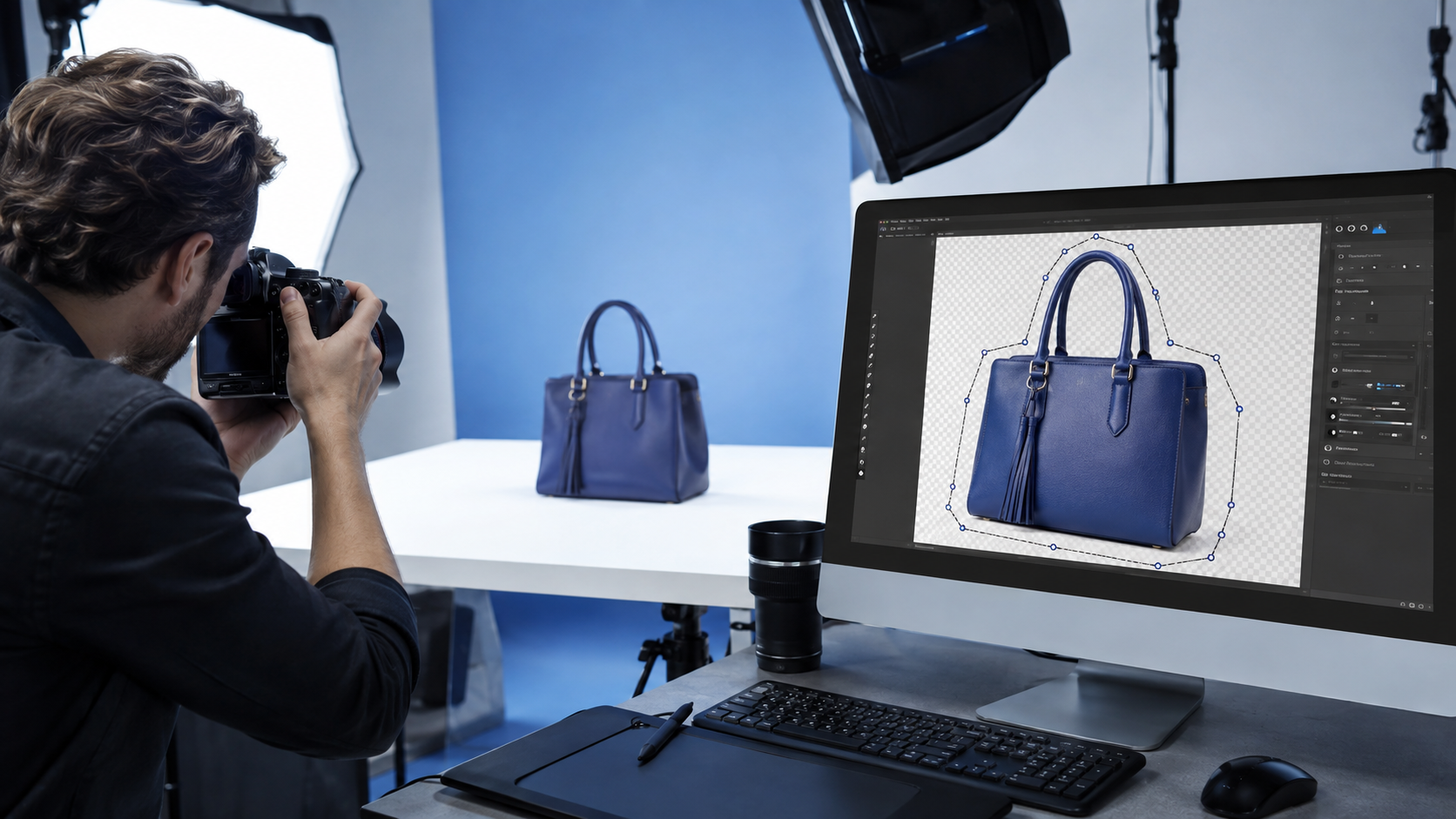
Why Clipping Path Is Important for Photographers and Studios
In professional photography, taking a great photograph is only part of the process. The final image often needs professional editing before it is ready for a client, website, advertising campaign, magazine, catalog, or social media platform. Among the many photo-editing techniques available today, clipping path remains one of the most useful and reliable methods for creating clean, professional images.
But why clipping path is important for photographers and photography studios?
A clipping path allows editors to isolate a subject from its original background with precision. Once the subject has been separated, the background can be removed, replaced, modified, or edited independently. This gives photographers greater control over the final appearance of their images.
For photographers and studios working with products, portraits, fashion, commercial campaigns, real estate images, or advertising photography, clipping path can make the editing process significantly more flexible.
Professional clipping path techniques are especially valuable when an image needs a clean outline, a transparent background, a white background, or precise object selection. Instead of relying on automatic background removal tools that may produce rough edges, a carefully created clipping path follows the subject’s contours and produces a polished result.
In this detailed guide, we will explain why clipping path is important, how it works, its major benefits for photographers and studios, and when professional clipping path services can be useful.
What Is a Clipping Path?

A clipping path is a vector-based outline created around an object or subject in an image. It is generally created using a pen tool in professional image-editing software such as Adobe Photoshop.
The path follows the outer edges of the subject as accurately as possible. Once the path is complete, the editor can use it to separate the selected object from the background.
For example, imagine a photographer takes a product photograph of a pair of shoes against a studio background. The photographer may need the shoes to appear on a pure white background for an online store. A clipping path can be created around the shoes, allowing the editor to isolate them from the original background and place them on a new one.
The same process can be used for clothing, furniture, electronics, accessories, bottles, cosmetics, jewelry, and many other objects.
A clipping path is particularly effective for subjects with relatively clear and defined edges. Complex images involving hair, fur, transparent objects, smoke, or intricate details may require additional techniques such as masking or advanced image extraction.
Why Clipping Path Is Important for Photographers
Photographers often focus on lighting, composition, camera settings, lenses, and styling. However, professional post-production is equally important when delivering polished images to clients.
Here are some of the main reasons why clipping path is important for photographers and photography studios.
1. It Creates Clean and Professional Images
One of the biggest benefits of clipping paths is the ability to create extremely clean subject edges.
A poorly removed background can make an otherwise excellent photograph look unprofessional. Rough edges, unwanted pixels, halos, and visible background fragments can reduce the quality of an image.
A manually created clipping path gives the editor control over the object’s outline. This is especially important for commercial photography where every detail can affect how the final image is perceived.
For photographers, clean images can help demonstrate professionalism and increase the perceived value of their work.
2. It Makes Background Removal Easier
Image background removal is one of the most common requirements in commercial photography.
A client may request a product on a white background, transparent background, colored background, or completely different environment. Without an accurate selection, making these changes can be difficult.
A clipping path provides a clear separation between the foreground object and the background.
Once the path is created, the editor can:
- Remove the existing background
- Create a transparent background
- Add a white background
- Change the background color
- Place the subject into another composition
- Create marketing variations
- Prepare images for catalogs and websites
This flexibility is one of the key reasons clipping paths remain popular in professional photo editing.
3. It Gives Photographers Greater Editing Control
Automatic background removal tools can be convenient, but they do not always provide the level of control required for professional photography.
AI-based tools may sometimes misunderstand object boundaries, especially around small details, thin edges, reflective surfaces, or unusual shapes.
A manual clipping path allows the editor to decide exactly where the selection should begin and end.
This level of control is valuable when the final image will be used in:
- Product catalogs
- Advertising campaigns
- Print materials
- Online stores
- Brochures
- Magazines
- Social media campaigns
- Commercial websites
For professional photographers, having control over the final image is essential.
4. Clipping Path Improves Product Photography
Product photography is one of the areas where clipping paths are particularly useful.
Online stores and brands often require consistent product images. Products may need to appear on the same background, with similar spacing, positioning, and visual presentation.
For example, an online fashion store may have hundreds of clothing images photographed under different conditions. The company may want every product to appear against a clean white background.
A clipping path can help editors isolate each product and create a consistent presentation.
This can improve the visual appearance of an entire product catalog.
For photographers who specialize in commercial or product photography, offering high-quality cutout images can also make their services more attractive to businesses.
5. It Helps Create Consistent Client Deliverables
Professional photography studios often work with large batches of images.
A client may expect every image to have the same:
- Background color
- Subject placement
- Crop
- Size
- Alignment
- Visual style
- File format
Clipping paths can help establish consistency across a collection of images.
For example, a photographer shooting 200 products for a brand can provide images with clean and uniform backgrounds. This consistency is particularly important for e-commerce websites and printed catalogs.
When clients receive consistent images, the overall quality of the project appears more professional.
6. It Supports E-Commerce Photography
The growth of online shopping has increased the demand for professionally edited product images.
E-commerce businesses need product photos that clearly show what customers are buying. Distracting backgrounds can make products harder to understand and may make a website look inconsistent.
Clipping paths allow photographers and editors to prepare images specifically for online stores.
A product can be isolated from its original environment and placed against a clean background.
This is useful for products such as:
- Shoes
- Clothing
- Bags
- Watches
- Electronics
- Furniture
- Cosmetics
- Kitchen equipment
- Jewelry
- Accessories
- Household products
For photographers working with online retailers, understanding clipping paths can therefore be an important part of a commercial photo-editing workflow.
7. It Makes Background Replacement Possible
Sometimes the original background of a photograph does not meet the client’s requirements.
A client may want a simple studio-style background instead of a busy environment. In other situations, the same subject may need to be placed on several different backgrounds for different marketing campaigns.
A clipping path makes this process easier.
After isolating the subject, an editor can place it on a new background without affecting the object itself.
This gives businesses more creative flexibility.
For example, the same product image could be prepared with:
- A white background for an online store
- A dark background for an advertisement
- A colored background for a promotional campaign
- A transparent background for graphic design
- A lifestyle background for social media
Photographers can therefore deliver multiple versions of the same photograph without needing to reshoot the product.
8. It Helps Save Photography and Editing Time
Time is extremely valuable for professional photographers.
A photography studio may have to process hundreds or thousands of images after a shoot. Spending too much time manually recreating selections or correcting backgrounds can slow down the entire workflow.
A well-created clipping path can make repetitive editing tasks more efficient.
Once an object has been accurately isolated, the same selection can often be used for multiple editing purposes.
For studios with high-volume commercial photography projects, an organized clipping path workflow can help reduce post-production time.
9. It Can Reduce the Need for Reshoots
Reshooting a product or commercial scene can be expensive.
Sometimes the photography itself is good, but the client wants a different background or presentation. If the subject can be cleanly isolated, the photographer may be able to solve the problem through post-production instead of organizing another photo shoot.
For example, suppose a client initially requests a gray background but later decides that all products should be presented on white.
If the product edges are suitable for clipping, the existing photographs may be edited rather than reshot.
This can save time, studio costs, equipment costs, and production effort.
10. It Is Useful for Catalog and Advertising Design
Professional photographs are often reused across different marketing materials.
A single image might appear on a website, printed catalog, social media post, brochure, advertisement, or promotional banner.
Each platform may have different design requirements.
An accurately isolated subject provides designers with greater flexibility. They can resize, reposition, and combine the subject with different graphic elements without being restricted by the original background.
This is especially useful for photographers who provide images to advertising agencies, graphic designers, retailers, and marketing teams.
11. It Improves the Appearance of Product Catalogs
Catalog design depends heavily on visual consistency.
When products are displayed against inconsistent backgrounds, different lighting conditions, or distracting environments, the catalog can look unorganized.
Clipping paths help create a uniform presentation.
For example, a furniture catalog may contain photographs taken in different locations. By isolating the furniture pieces and placing them on consistent backgrounds, designers can create a more cohesive catalog.
This is another important reason why clipping path is important for commercial photographers.
12. It Is Valuable for Fashion Photography
Fashion photographers and studios can also benefit from clipping path techniques.
Clothing items often need to be isolated for:
- Online fashion stores
- Catalogs
- Lookbooks
- Promotional graphics
- Advertising campaigns
- Product listings
A precise outline around clothing allows editors to change the background and prepare different image variations.
However, clothing can sometimes contain complex details such as folds, thin straps, lace, and semi-transparent areas. These images may require clipping paths combined with masking and other advanced image-editing techniques.
13. It Helps Jewelry and Accessories Photography
Jewelry and accessories can require highly precise editing.
Products such as watches, necklaces, bracelets, handbags, and sunglasses often need clean presentation for online stores and advertisements.
Clipping paths can help separate solid product areas from the background. For highly complex objects, additional masking techniques may be needed to preserve transparency, reflections, shadows, and fine details.
For photographers working with luxury products, precision is especially important because even small editing errors can affect the perceived quality of the product.
14. It Supports Professional Photo Editing Workflows
Professional photography is usually a combination of multiple stages:
- Planning
- Shooting
- Selection
- Color correction
- Retouching
- Background editing
- Cropping and resizing
- Quality control
- Exporting
- Delivery
Clipping paths can fit into the background-editing stage of this workflow.
When used correctly, they help create a structured approach to separating subjects from their surroundings.
This can be particularly valuable for photography studios that need repeatable editing processes.
Manual Clipping Path vs. Automatic Background Removal
Modern AI-powered editing tools can remove backgrounds within seconds. So why do professionals still use manual clipping paths?
The main difference is precision and control.
Automatic tools analyze an image and attempt to identify the subject. They can work extremely well on many photographs, but the results are not always perfect.
A manual clipping path allows a skilled editor to define the subject boundary point by point.
Manual Clipping Paths Are Useful When:
- The object has hard, defined edges
- The client requires high precision
- The image will be used commercially
- The product has an unusual shape
- Automatic selection produces unwanted edges
- Consistency across many images is important
Automatic Tools Can Be Useful When:
- A large number of simple images need quick processing
- Perfect precision is not essential
- The background is easy to distinguish
- The project has a limited budget or turnaround requirement
In professional workflows, the two approaches do not necessarily have to compete. Many studios use automation for initial processing and manual techniques for quality control and complex images.
When Should Photographers Use a Clipping Path?
Not every photograph requires a clipping path.
The technique is most useful when the subject has a clearly defined edge and needs to be separated from its background.
Common examples include:
Product Photography
Products with defined shapes are ideal candidates for clipping paths.
Fashion Photography
Clothing and accessories can often be isolated for catalogs and e-commerce.
Commercial Photography
Advertising campaigns frequently require flexible image compositions.
Catalog Photography
Large collections benefit from consistent backgrounds and presentation.
E-Commerce Photography
Online retailers commonly require clean product cutouts.
Advertising Photography
Designers may need isolated subjects to create promotional layouts.
When Is a Clipping Path Not Enough?
Although clipping paths are powerful, they are not the best solution for every image.
Some subjects contain complicated edges that are difficult to represent with a basic vector path.
Examples include:
- Human hair
- Animal fur
- Feathers
- Smoke
- Transparent glass
- Fine lace
- Semi-transparent fabric
- Trees and leaves
- Complex shadows
For these images, editors may combine clipping paths with techniques such as:
- Layer masking
- Alpha channel masking
- Hair masking
- Color correction
- Shadow creation
- Image compositing
The goal is always to select and preserve the subject naturally rather than simply cutting around its approximate shape.
How a Professional Clipping Path Is Created
Creating a high-quality clipping path requires attention to detail.
A typical workflow looks like this:
Step 1: Open the Image
The editor opens the high-resolution photograph in professional image-editing software.
Step 2: Analyze the Subject
Before creating the path, the editor identifies the subject’s edges and determines which areas should be included.
Step 3: Create Anchor Points
Using a pen tool, the editor places anchor points around the subject.
Step 4: Adjust Curves
Curves are adjusted to follow rounded edges naturally.
Step 5: Refine Difficult Areas
Corners, curves, handles, straps, and other details are carefully reviewed.
Step 6: Close the Path
The path is completed around the entire subject.
Step 7: Create the Selection
The completed path can be converted into a selection.
Step 8: Remove or Replace the Background
The editor can then remove the original background or place the subject on a new one.
Step 9: Perform Additional Retouching
Color, shadows, contrast, reflections, and other elements can be adjusted.
Step 10: Export the Final Image
The finished image is saved according to the client’s required format and specifications.
A professional editor should also inspect the final image at high magnification to identify unwanted pixels, jagged edges, halos, or other imperfections.
How Clipping Path Services Help Photography Studios
Photographers and studios do not always have the time or resources to handle every editing task internally.
Large projects can require hundreds or thousands of images, and detailed clipping can be time-consuming.
This is where a professional clipping path service can be useful.
Outsourcing clipping path work can allow photographers to focus on photography, client communication, creative direction, and business development while experienced editors handle repetitive post-production tasks.
A professional service may provide:
- Manual clipping paths
- Background removal
- Image masking
- Photo retouching
- Image resizing
- Shadow creation
- Color correction
- E-commerce image editing
- Bulk image processing
Before choosing a service provider, photographers should evaluate factors such as editing quality, turnaround time, communication, consistency, data handling, and revision policies.
Benefits of Outsourcing Clipping Path Work
Saves Time
Photographers can spend more time shooting and managing clients instead of performing repetitive editing tasks.
Supports Large Projects
Professional editing teams can often handle large batches more efficiently than an individual photographer.
Provides Specialized Skills
Experienced editors may be better equipped to handle complex selections and commercial requirements.
Improves Workflow
Outsourcing can create a more predictable post-production process.
Helps Meet Deadlines
Faster editing support can be particularly useful when clients have strict delivery schedules.
For busy studios, outsourcing can therefore become a practical part of the overall production workflow.
How to Choose a Clipping Path Service
If you decide to outsource your editing, do not choose a provider based only on price.
Look for a service that demonstrates consistent quality.
Consider the following factors:
1. Portfolio Quality
Review examples of previous work, especially images similar to your own projects.
2. Manual Editing Expertise
Ask whether the company provides manually created clipping paths when precision is required.
3. Turnaround Time
Make sure the provider can meet your deadlines consistently.
4. Revision Policy
Understand what happens if an image does not meet your expectations.
5. Communication
Fast and clear communication is important for large projects.
6. File Handling
Professional studios should consider how image files are transferred, stored, and managed.
7. Consistency
A service should be able to maintain the same editing standards across large batches.
Why Clipping Path Is Important for Your Photography Business
For photographers, image quality is directly connected to professional reputation.
Clients often judge a photographer’s work based not only on the original photographs but also on the final delivered images.
High-quality post-production can make photographs more versatile and commercially useful.
If you regularly work with businesses, brands, online retailers, advertising agencies, or design teams, clipping path skills can become an important part of your service offering.
Even if you outsource the actual editing, understanding the process helps you communicate more effectively with editors and clients.
You can identify which images require clipping paths, which require masking, and which require additional retouching.
This knowledge can make project planning easier and help you provide more accurate quotations and delivery estimates.
Clipping Path and the Future of Photography Editing
Photo editing continues to evolve.
Artificial intelligence, automated selection tools, cloud-based workflows, and advanced image-processing technologies are making many editing tasks faster.
However, automation does not eliminate the need for professional judgment.
Commercial clients still expect accurate, natural-looking, and consistent results.
The future of photo editing will likely involve a combination of automation and human expertise. Automated tools can handle repetitive tasks, while experienced editors can refine complex areas and ensure that final images meet professional standards.
For photographers and studios, learning how different editing techniques work can therefore provide a long-term advantage.
Final Thoughts: Why Clipping Path Is Important
So, why clipping path is important for photographers and photography studios?
The answer comes down to control, precision, flexibility, and professional presentation.
A properly created clipping path allows photographers and editors to separate subjects from backgrounds, create clean product images, prepare photographs for e-commerce, develop consistent catalogs, and produce flexible marketing assets.
For commercial photographers, these benefits can make post-production more efficient and help deliver images that meet demanding client requirements.
Clipping paths are not the solution for every photograph. Images with hair, fur, transparency, or highly complicated edges may require masking and other advanced techniques. However, for products and subjects with defined edges, a carefully created clipping path remains one of the most reliable methods for professional image isolation.
Whether you handle editing yourself or work with a professional clipping path service, understanding this technique can help you improve your photography workflow and deliver more polished results.
In an increasingly visual digital marketplace, the quality of the final image matters. A strong photograph combined with precise post-production can help photographers and studios stand out, satisfy clients, and create images that are ready for websites, catalogs, advertisements, and other professional applications.
Frequently Asked Questions
1. Why clipping path is important in photography?
Clipping path is important because it allows photographers and editors to precisely separate a subject from its background. This makes it easier to remove or replace backgrounds, create transparent images, prepare product photographs, and maintain consistent visual presentation across commercial projects.
2. Is clipping path better than automatic background removal?
A manual clipping path can provide greater precision and control than automatic background removal, particularly for commercial images with clearly defined edges. Automatic tools can be faster for simple images, while manual clipping is often preferred when accuracy and professional quality are critical.
3. Do photographers need professional clipping path services?
Photographers who handle large volumes of commercial, product, fashion, or e-commerce images may benefit from professional clipping path services. Outsourcing can save editing time, provide access to experienced editors, and help studios meet demanding client deadlines while focusing on photography and creative work.
1. Why clipping path is important in photography?
Clipping path is important because it allows photographers and editors to precisely separate a subject from its background. This makes it easier to remove or replace backgrounds, create transparent images, prepare product photographs, and maintain consistent visual presentation across commercial projects.
2. Is clipping path better than automatic background removal?
A manual clipping path can provide greater precision and control than automatic background removal, particularly for commercial images with clearly defined edges. Automatic tools can be faster for simple images, while manual clipping is often preferred when accuracy and professional quality are critical.
3. Do photographers need professional clipping path services?
Photographers who handle large volumes of commercial, product, fashion, or e-commerce images may benefit from professional clipping path services. Outsourcing can save editing time, provide access to experienced editors, and help studios meet demanding client deadlines while focusing on photography and creative work.
